A Guide to Selecting Fixed Hydraulic Dock Leveler?
Blog 2026-08-08
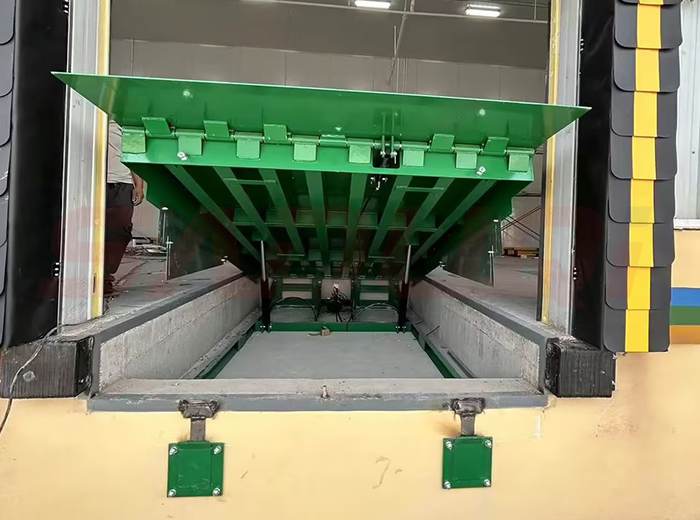
The fixed hydraulic dock leveler comprises a non-slip chequered steel deck, a main lifting cylinder, a lip plate cylinder, an integrated hydraulic power unit, an electronic control system, safety guarding components and a main load-bearing steel beam frame. The entire unit is recessed into the loading bay pit and, when not in use, sits flush with the loading bay, thus not occupying any aisle space.
Dock Leveler standard Load Capacity Applications
6-tonne dynamic load capacity
Suitable for: 2-tonne manual pallet trucks, light-duty 1.5-tonne electric forklifts; small, light goods; average daily vehicle movements < 20;
Limitations: Not suitable for frequent heavy loads or heavy-duty container lorries.
8-tonne dynamic load capacity (general-purpose model for small to medium-sized warehouses)
Suitable for: 2.5–3-tonne electric forklifts; primarily for daily consumer goods, small raw materials, and 4.2-metre / 6.8-metre box vans;
10-tonne dynamic load capacity (mainstream standard specification, recommended for the vast majority of warehouses)
Suitable for: 3–3.5-tonne lithium-ion forklifts, standard containers, high-frequency loading and unloading (30–80 trips per day);
Recommendation: For new warehouses, select the 10-tonne model directly to prevent deformation caused by overloading during long-term use.
12–15-tonne dynamic load capacity (heavy-duty industrial / logistics parks)
Suitable for: 5-tonne internal combustion forklifts, heavy loads such as steel and equipment, large-scale logistics transhipment centres, and full-load heavy goods vehicles;
20-tonne dynamic load capacity (ports, heavy industrial sites)
Suitable for: heavy-duty forklifts of 7 tonnes or more, large lorries, and heavy-duty pallets.
Selecting dock leveler dimensions (to accommodate forklift turning radius and lorry width)
Standard Width (W)
1830 mm: Narrow loading bays, single-sided forklift access; suitable only for small-batch warehouses;
2000 mm (most common): Compatible with 95 per cent of domestic lorries; allows forklifts to pass each other in both directions and ensures smooth pallet handling;
2200–2500 mm: Large logistics parks, simultaneous operation of two forklifts, wide-body containers.
Standard length (L, which determines the ramp gradient; a gradient of ≤1:6 is safest)
Excessively steep gradients can cause cargo to slide and result in forklift vibration; the length is determined by the loading bay height:
Loading bay height 1100 mm (primarily for 4.2-metre light goods vehicles): platform length 2000/2440 mm;
Loading bay height 1,200–1,300 mm (mainly for standard containers): 2,440 mm (2.44 metres) – industry standard;
Loading bay height 1,400–1,500 mm (high-cube containers and heavy goods vehicles): extended to 2,700/3,000 mm to reduce the gradient.
Dock leveler lifting adjustment travel (to accommodate different vehicle height differences)
Standard travel: Up +400 mm / Down –300 mm (covers all domestic lorries)
Up +400 mm: For docking with high-sided heavy goods vehicles and high-cube containers that are higher than the loading bay;
Lower by 300 mm: for docking with 4.2-metre low-body light lorries and flatbed lorries that are lower than the loading bay;
Special customisation: +500/-400 mm (for ports and industrial sites with extreme height differences)
Recommended standard loading bay height: New warehouses should uniformly be constructed at 1,250–1,300 mm to accommodate all vehicle types, ensuring ample platform travel reserve.
Dock leveler dimensions for the foundation pit
Taking the standard 2440 × 2000 mm, 10-tonne model as an example:
Platform surface: 2440 (length) × 2000 (width)
Internal clear dimensions of the foundation pit: 2600 × 2060 × 510 mm (length × width × depth)
Civil engineering requirements:
The pit base must consist of C30 concrete with a thickness of ≥200 mm, providing integral load-bearing capacity, with waterproofing and drainage channels along the sides;
Angle steel must be embedded around the perimeter of the pit, with a horizontal deviation of ≤3 mm/m;
Depth: 500–600 mm; must not be less than 480 mm, otherwise the platform cannot be fully retracted;
Installation positions for rubber bumpers must be provided on both sides at the front of the foundation pit.
Selection of Hydraulic and Power Systems for Dock Leveler
Motor Power
6/8 tonnes: 0.75 kW; 10/12 tonnes: 0.75–1.5 kW; 1.5 kW as standard for 15 tonnes and above; power supply is uniformly 380 V, three-phase, five-wire.
Hydraulic Cylinder Configuration (Key Points to Avoid Pitfalls)
Dual-cylinder configuration (lifting cylinder + lip plate cylinder) provides stability and is recommended;
Single-cylinder models are lower in price but are prone to tilting under heavy loads; they are not recommended for frequent loading and unloading operations.
Hydraulic Power Unit
Integrated, built-in power unit with leak-proof design; for cold storage applications, low-temperature, freeze-resistant hydraulic oil is required.
Dock levler safety features
Standard specification
8 mm non-slip patterned platform surface, 16 mm reinforced lip;
Hydraulic anti-drop safety valve (automatically locks upon pressure loss to prevent sudden platform descent);
Mechanical maintenance support strut (with safety lock for servicing);
Anti-pinch skirting on both sides to prevent forklift operators’ feet from being trapped;
Rubber bumpers on the outer edges of the loading bay (to protect lorries and equipment).
Standard upgrades
One-button electrically controlled lifting with emergency stop button;
Hydraulic cushioning to ensure shock-free forklift access;
Non-slip edging around the perimeter of the platform.