Detailed Differences Between Cold Storage High Speed Doors and Standard High Speed Doors
Blog 2026-10-27
Thanks to their rapid opening and closing and sensor-activated operation, high-speed doors are widely used in industrial plants, logistics warehouses, cleanrooms, cold chain facilities and cold stores.
Many customers tend to confuse cold store high speed doors with standard PVC high speed doors; whilst the two may appear similar and both feature rapid opening and closing, their design principles, material composition and suitable environments are entirely different.
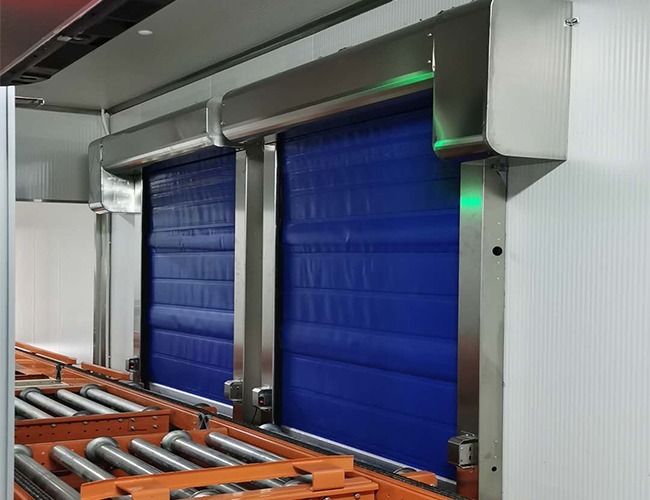
Whilst standard high-speed doors are primarily designed for dust containment, the core purpose of cold store high-speed doors is to maintain temperature, prevent freezing and frost build-up, and reduce the energy consumption of the cold store’s refrigeration system. The two types must not be used interchangeably; selecting the wrong type can lead to a range of problems, including the door curtain freezing and cracking, the tracks becoming jammed due to ice build-up, significant loss of cold air, and a sharp rise in electricity bills.
Different Usage Scenarios
Standard high speed doors: also known as conventional PVC high speed flexible curtain doors, are general-purpose partition doors designed for workshops at ambient temperatures. They are generally suitable for environments ranging from –5 °C to +60 °C and are commonly used for internal partitioning in factory buildings, cleanrooms, sorting and logistics corridors, and areas requiring protection against insects and dust.
Their key benefits are rapid opening and closing, minimising the ingress of dust, insects and air currents, and improving the efficiency of forklift traffic; there are no strict requirements regarding thermal insulation performance.
Cold stores high speed doors: These are specialised high-speed doors designed specifically for the cold chain, suitable for use in fresh-keeping, chilled and frozen storage facilities, as well as cold store buffer rooms. They are typically capable of operating reliably in environments down to –30 °C, whilst certain cryogenic models support operating conditions as low as –35 °C.
Due to the significant temperature difference between the interior and exterior of cold stores, the convergence of cold and warm air can easily lead to condensation, frost and ice formation. The primary design priority for these doors is thermal insulation and the prevention of heat transfer, followed by rapid access; they constitute a vital component of energy-efficient cold chain systems.
Differences in Door Curtain Materials and Insulation Structures
Standard high speed doors: These utilise a single layer of PVC-coated polyester fibre curtain fabric, with a thickness of 0.8–1.2 mm. They feature only a single partition layer and contain no insulating core material. A few ‘thickened’ variants merely increase the thickness of the PVC coating and do not provide any thermal insulation.
This type of PVC material hardens and becomes brittle rapidly in sub-zero temperatures; it is prone to cracking and tearing after repeated bending, and is therefore unsuitable for long-term use in cold stores.
The curtain of the cold store rapid-action door features a sandwich-composite insulation structure: two layers of special low-temperature-resistant PVC fabric, with high-density PU insulation foam filled in between, giving a total thickness of 20–40 mm. The PVC material has been modified for low-temperature use, ensuring it remains flexible even in sub-zero conditions and does not become hard, brittle or crack.
High-end cold store solutions may also utilise thermal-break rigid polyurethane door panels, which offer superior thermal insulation and a lower thermal conductivity, thereby minimising heat transfer into the storage area as much as possible.
Differences in Sealing System Standards
Standard high speed doors sealing solutions primarily consist of brush seals on both sides and a rubber strip at the bottom. As the gaps between the brushes are relatively large, the airtightness is only moderate; they are capable of blocking dust and insects, but in the pressure differential environment of a cold store, cold air can easily escape through these gaps. Consequently, they are not suitable for operating conditions with significant temperature differentials.
Cold store high speed doors come as standard with a zip-type track seal and a floating compression seal, complemented by a weighted soft pouch seal at the bottom. Once the door is closed, the edge of the curtain is firmly embedded within the track, ensuring a tight, all-round seal against the floor. Even when there is a significant pressure differential between the interior of the cold store and the outside environment, this design significantly reduces the escape of cold air and the infiltration of warm, humid air, thereby minimising frost build-up on the evaporator at source and reducing the load on the refrigeration unit.
Anti-freeze Heating System
This is a key feature that distinguishes genuine from counterfeit cold store high speed doors. The temperature difference between the inside and outside of a cold store can reach 20–30 degrees Celsius; when humid, warm air comes into contact with the cold guide rails, bottom edge and high speed door panel, frost and ice form rapidly.
Ordinary high speed doors lack any heating system; if installed in a cold store, the door curtain will become jammed once the guide rails freeze, rendering the door unable to open or close, whilst sensors and electrical control components will malfunction, resulting in an extremely high failure rate.
Cold store high-speed doors feature a built-in heating cable system within the guide rails, bottom edge and control box, which performs timed, constant-temperature defrosting and prevents ice build-up, ensuring the door operates smoothly in low-temperature environments. The heating system employs zone-specific temperature control, preventing ice formation whilst avoiding excessive additional heat load, thereby balancing stability with energy efficiency.
Impact-resistant Self-repairing Function
Some models of standard high speed doors offer a self-repairing option, but this is not a mandatory standard feature. The frequency of collisions in workshops is relatively low; even if damage occurs, the costs of repairing or replacing the curtain and the losses due to downtime remain manageable.
In cold stores, where forklift trucks enter and exit frequently, the likelihood of collisions is high. The losses resulting from cold store downtime and temperature loss are significant; therefore, self-repairing zips are standard equipment for rapid doors in cold stores. If a forklift collision causes the door curtain to derail, it will automatically return to the track during the next upward movement, eliminating the need for maintenance personnel to visit and dismantle the door. This reduces cold store downtime and lowers maintenance costs.
Differences in Frame Materials
Standard high speed doors are typically made from powder-coated cold-rolled steel sheet, which is highly susceptible to rust in the high-humidity, condensation-prone environment of cold stores; cold-store models, however, prioritise the use of 304 stainless steel or rust-resistant aluminium alloy frames, with hardware fittings offering a higher level of rust resistance to withstand corrosion from condensation and extend the service life.
Recommendations for Selecting the Right Model
Standard-temperature workshops, cleanrooms and general logistics corridors: Standard PVC high-speed doors should be selected directly to meet dust-proof access requirements and reduce investment costs;
0–5 °C fresh-keeping cold stores and buffer rooms: Economy-class insulated soft-curtain cold store high-speed doors may be selected;
Freezer rooms at -18°C and below: Must be fitted with a zip seal and a complete heat-tracing anti-freeze system. Do not use standard thickened PVC doors as a substitute for freezer doors, as this will result in high energy consumption and frequent breakdowns;
It is strictly prohibited to install standard high-speed doors directly in freezer room openings. Whilst this may appear to work in the short term, in the long term it will lead to persistent cold air leakage, frequent ice build-up and damage.