Smart Sensor-activated Opening Mechanism For High Speed Doors
Blog 2026-09-15
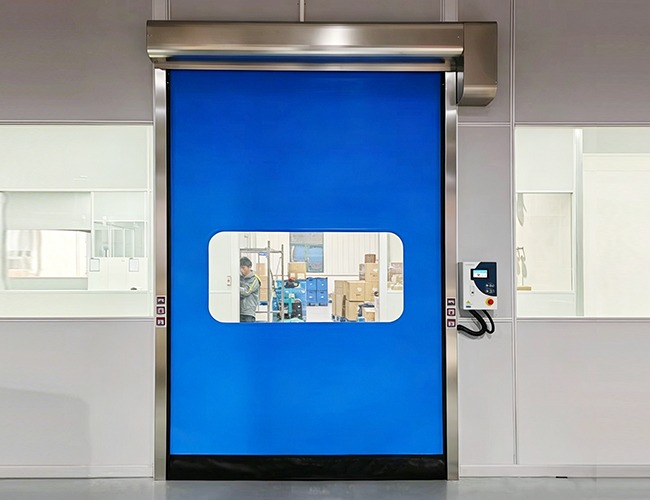
The various intelligent sensors on high-speed doors can automatically recognise vehicles, people and goods, eliminating the need for manual operation and improving traffic flow efficiency. They can distinguish between people and vehicles as required to minimise false openings, thereby reducing heat and cold loss from workshops and preventing the ingress of dust and insects.
Featuring both traffic-activated opening and anti-pinch protection when closing, these doors are suitable for workshops, logistics loading and unloading areas and other similar scenarios, whilst balancing energy efficiency, cleanliness and traffic safety.
Radar Microwave Sensors
Principle of Operation
Emits high-frequency microwave signals to detect moving objects (primarily metal vehicles) within the detection zone; can be configured to ignore stationary people or slow-moving pedestrians, thereby distinguishing between people and vehicles.
Installation Location
Above the door header and on both sides of the door frame, with adjustable detection height, distance and delayed closing.
Suitable Applications
Logistics corridors, lorry loading bays, and high-speed doors for vehicle access within factory premises; ideal where only lorries are permitted and unauthorised pedestrian access is to be prevented.
Advantages
Waterproof and dustproof; unaffected by light, dust or mist; long-range detection means vehicles do not need to stop; can be configured to recognise only motor vehicles.
Disadvantages
May be triggered by pedestrians moving at close range; requires calibration to distinguish between people and vehicles.
Infrared Photoelectric Sensors
Single-beam Infrared Photoelectric Sensors
Transmitter and receiver probes are installed on either side of the door jamb; the door opens when an object blocks the beam and closes after a delay once the object has passed.
Suitable for: small passageways, production lines and cleanrooms.
Limitations: Can only detect objects at the height of the beam; items below the beam will not trigger the door.
Multi-beam Safety Light Curtain
The entire height of the door frame is covered by infrared beams, providing full coverage from the floor to the top of the door. The door opens automatically when people, trolleys or goods pass through, whilst also providing anti-pinch protection.
Suitable for: food processing plants, pharmaceutical cleanrooms and passageways with frequent pedestrian traffic.
Advantages: Combines the dual functions of door-opening detection and anti-pinch protection upon closing.
Ground-mounted magnetic induction coils
Principle of Operation
A metal coil is embedded in a groove cut into the ground. When energised, it generates a magnetic field; as a metal vehicle enters the field, it alters the inductive signal, which is received by the controller to open the gate. Pedestrians and plastic trolleys, which contain no metal, do not trigger the system.
Installation
A ring-shaped ground-mounted induction loop is embedded in the ground at the entrance; available in single-coil or dual-coil configurations (separate for entry and exit).
Suitable Applications
Lorry loading bays, factory gates, and areas where only vehicle access is permitted, preventing unauthorised pedestrian entry.
Advantages
Highly accurate recognition; detects only metal vehicles with virtually no false triggers; resistant to dust, moisture and low temperatures.
Disadvantages
Requires ground trenching during installation; subsequent damage to the surface may affect detection; non-metallic forklifts and hand trolleys cannot trigger the system.
Photoelectric Diffuse Reflection Sensing
Principle
A sensor is installed on one side only; it emits infrared light which is reflected back by an object to trigger the door to open, eliminating the need for a two-way beam.
Installation
Can be fitted to a single side of the door frame or wall; installation is straightforward and requires no wiring on both sides.
Applications
Suitable for small high speed doors, simple warehouse passageways and the passage of lightweight trolleys.
Limitations
Strong light, reflective floors and dusty environments may cause false triggers or malfunctions.
Wireless Remote Control Activation
Handheld Remote Control
Operators carry the remote control with them and can open, close or pause the gate at the touch of a button; multiple remote controls can be configured for group management.
Long-Range Industrial Remote Control
Forklift drivers within the factory premises use an in-vehicle remote control to open the gate in advance from a distance of several dozen metres; suitable for large logistics parks.
Additional Features
The remote control can be configured with a delayed automatic closing function and a locking function, allowing doors to be locked with a single press at the end of the working day.
Pull-cord Switch
Structure
Nylon pull cords are fitted to the inside and outside of the door; when a person gently pulls the cord, a contact signal is transmitted to the controller to open the door.
Applications
Suitable for assembly line workstations and small high-speed doors within workshops; forklift operators and workers can open the door with a simple pull.
Advantages
Extremely low cost; unaffected by dust or moisture. The disadvantage is that manual operation is required, as it is not an automatic sensor system.
Card Swipe / Facial Recognition / Fingerprint Access Control Integration
Bluetooth Proximity Sensing
The door opens automatically when a mobile phone’s Bluetooth signal comes within a preset distance of the door; it closes after a delay when the phone moves away. The system is linked to authorised users’ mobile phones; unauthorised users are denied access.
Manual Control via Mobile App
Remotely open and close the door via a mobile app, view the door’s operation log, and receive fault alert notifications.
Applications
Cleanrooms, office corridors, and dedicated internal corporate access routes where strict access control is required.
Dual-mode combination sensing: radar and ground-sensor
Connect both the microwave radar and the ground-loop sensor to the controller simultaneously:
The long-range radar detects vehicles in advance;
The ground-loop sensor accurately confirms that a vehicle has arrived; this dual verification significantly reduces false door openings caused by pedestrians or debris;
Standard configuration for large warehouses and loading bays.
Summary of Access Control System Selection
For goods vehicles only, with no pedestrian access: Inductive loops / Radar-based pedestrian-vehicle separation mode;
For areas with frequent mixed pedestrian and vehicle traffic, and cleanrooms: Full-height infrared light barriers;
Personnel access for dust-free and sterile cleanrooms: Hand-scanning infrared + facial recognition;
Remote operation by forklift drivers: On-board wireless remote control;
Smart access control for factory premises: Bluetooth app + card-based access control integration;
Low-cost, simple workshop access points: diffuse reflection photoelectric sensors, pull-cord switches;