The difference between high-speed roller shutters and high-speed stacking doors
Blog 2026-08-02
High-speed roller doors and high-speed stacking doors are both types of PVC high-speed doors, but they differ entirely in terms of their operating mechanisms, structure and suitable applications.
Core Operating Principles (Fundamental Differences)
1. High-speed roller shutters
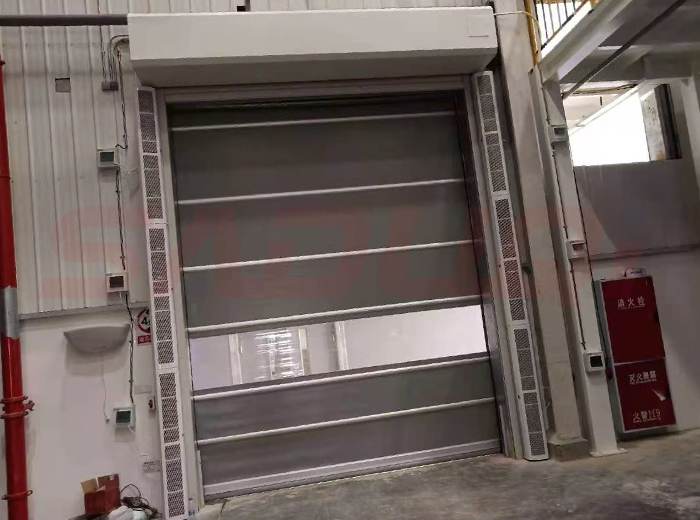
The door curtain is wound upwards onto the top roller and retracted into the headbox, much like rolling up a piece of fabric.
Drive mechanism: The motor directly drives the roller shaft to retract the curtain.
Head section: Requires space to accommodate the roller; features a cylindrical structure running horizontally.
2. High Speed Stacking Doors
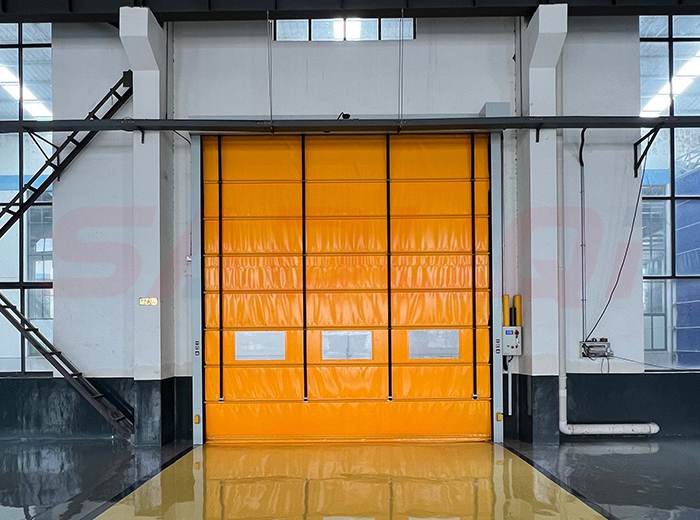
Rather than using a roller, high-strength lifting straps on both sides fold the door curtain upwards in layers and stack it at the top of the opening; the curtain is stacked flat, not rolled up.
Drive mechanism: The roller shaft only wraps around the lifting straps on both sides; the curtain itself is not rolled up.
Curtain head: The top features a flat stacking compartment with no large rollers.
Comparison Table of Key Parameters
| Comparison | high-speed doors | High-speed stacking doors |
| Clearance height at the top | Only 300–450 mm is required above a small opening | Requires 600–1200 mm of clearance space; cannot be installed if the ceiling height is insufficient |
| Maximum door opening dimensions | Standard width ≤ 6 m, height ≤ 6 m; extra-wide openings are prone to swaying Extra-large openings | with a maximum width of 12 m and height of 12 m, are suitable for logistics vehicle access |
| Wind resistance | Features built-in slender aluminium alloy wind braces; suitable for indoor use only in winds of Force 6–8 | Multiple reinforced steel cross-braces provide resistance to strong winds of Force 10–12; suitable for use as external doors for industrial buildings and open-air walkways |
| Operating noise | The drum rotation is slightly noisy | The belt lifts and stacks the items, ensuring smoother operation and lower noise levels |
| Sealing Performance | Side brush seals ensure a high level of cleanliness, making them suitable for cleanrooms | Double-layer side brushes combined with a weighted airtight fabric at the base provide enhanced wind and dust resistance |
| Opening and closing speed | Upwards: 0.8–2.2 m/s, faster | Upwards: 0.6–1.5 m/s, slightly slower than a roller shutter |
Distinction between applicable scenarios
Applications for High-Speed Roller Shutters
Internal partitions and cleanrooms: food, pharmaceutical and electronics cleanrooms, changing rooms, and production line partitioning;
Narrow door openings (width ≤ 5 m) with limited headroom above the opening (insufficient space above the door);
No strong winds; for indoor use only, where rapid opening and closing and low cost are prioritised;
Cold stores and temperature-controlled workshops, where the emphasis is on thermal insulation, dust prevention and rapid separation of hot and cold air;
Applications for High-Speed Stacking Doors
Outdoor main entrances, logistics loading bays and lorry access points, with wide door openings (5 metres or more);
Perimeter wind-exposed areas of factory premises, coastal facilities prone to strong winds, and external warehouse doors requiring high wind resistance;
Underground car park entrances and exits, access points for large equipment, and passageways with frequent lorry traffic;
Scenarios requiring high durability of the door curtain, such as long-term, high-frequency operation and frequent contact with heavy vehicles;