Detailed Introduction to Spiral High Speed Door
Blog 2026-08-24
Spiral high speed door, also known as rigid high-speed doors, aluminium alloy high-speed doors or spiral high-speed doors, are a new type of metal industrial door that combines rapid opening and closing, thermal insulation, dust-tight sealing, wind resistance and burglary protection.
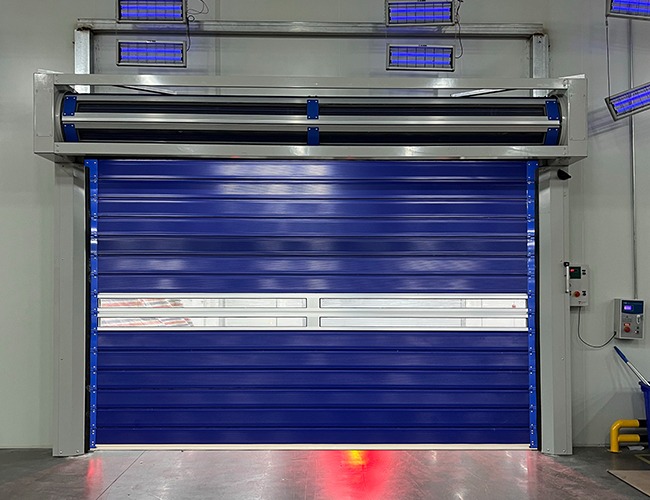
The door body consists of double-layered aluminium alloy panels filled with polyurethane foam insulation. When opened, the panels roll upwards along spiral tracks on both sides, ensuring that the panels do not come into contact with one another and thus avoid friction. Operating speeds can reach 0.8–2.35 m/s, which is more than six times faster than traditional industrial sectional doors, and they are gradually replacing traditional sectional doors and standard roller shutters.
Spiral High Speed Door Principle of Operation
The core feature of the Turbine High-Speed Hard-Panel Door lies in its dual-helix turbine guide and load-bearing track system:
Lifting Process
Specially designed guide wheels and roller pulleys are fitted at both ends of the door panel, allowing it to travel upwards along the vertical track; upon reaching the top, the guide wheels enter the helical turbine track, and the door panels are wound section by section onto the roller shaft along a helical path.
Roll-up Characteristics
Owing to the helical design of the turbine track, once the door is wound onto the roller, a certain gap is maintained between each panel, preventing surface-to-surface friction and effectively reducing operating noise and panel wear.
Lowering Process
The drive system operates in reverse, releasing the door panels section by section from the helical track; they descend smoothly along the vertical track, with the bottom seal fitting tightly against the floor.
Drive System
A servo motor combined with a microcomputer-controlled variable-frequency speed regulation system, coupled with tension torque balancing technology, ensures high-speed and smooth operation of the spiral high speed door; manual opening is possible in the event of a power cut.
Spiral High Speed Door Composition
| Component | Function Description |
| Door Curtain | Double-layered aluminium alloy door panels, filled with polyurethane foam insulation, approximately 40–42 mm thick, forming the main structure of the door |
| Track System | vertical guide rails + helical worm gear guide rail assembly, which guides the door panel’s vertical movement and retraction, utilising rolling friction from the guide wheels |
| Drive System | Dedicated servo motor / door opener, with a safety factor of ≥1.3, providing lifting power, low noise and a long service life |
| Control System | Microcomputer-based PLC + variable-frequency drive, enabling variable-frequency speed control, smooth start-up and stopping, and control via multiple operating modes |
| Safety Systems | Infrared photoelectric protection, bottom safety airbag (rebounds upon encountering an obstacle), emergency stop button, fall arrest device |
| Sealing System | Soft sealing strips between the door panels, EPDM sealing strips on both sides, and an air-cushion sealing strip at the bottom, forming an airtight barrier |
| Opening Methods | Remote control, radar, geomagnetic sensor, card swipe and other sensor-based opening methods |
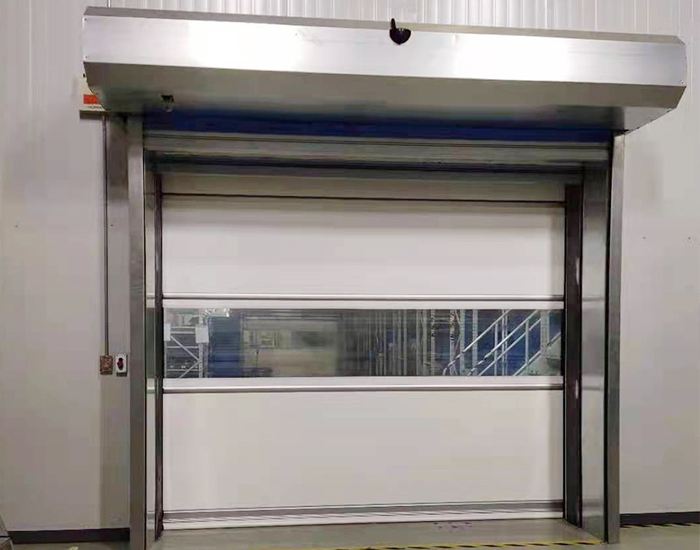
| Optional accessories | Transparent viewing window (approximately 1 m above the floor) |
Spiral High Speed Door Technical Specifications
| Parameters | Technical Specifications |
| Door panel material | 0.7–1.0 mm double-layer aluminium alloy, with a rolled or flat surface finish |
| Door panel thickness | 40–42 mm (filled with high-density polyurethane foam) |
| Door frame material | 2.5 mm galvanised steel frame with a baked-on finish |
| Opening speed | 0.8 – 2.35 m/s (adjustable) |
| Closing speed | 0.6–1 m/s (adjustable) |
| Wind resistance | ≤ 30 m/s, wind resistance class 10 |
| Thermal insulation performance | K-value ≈ 0.4 W/(m²・K) |
| Frequency of use | Number of opening and closing cycles ≥ 800 per day (high-frequency continuous operation) |
| Power requirements | 220V / 380V, 50Hz, 14A |
| Protection rating | IP54 (water- and dust-resistant) |
| Track types | Helical-tapered track / S-shaped track / Vertical track (optional) |
| Standard colours | white, silver, natural aluminium (custom colours available on request) |
Spiral High Speed Door Applications
Spiral high speed doors are suitable for industrial and commercial access points that require frequent opening and closing and have specific requirements for thermal insulation, sealing and wind resistance:
Logistics and Warehousing: Logistics distribution centres, warehouse entrances and exits, cold chain buffer zones, multi-storey car parks
Food and Beverage: Food processing plants, cleanrooms, temperature-controlled warehouses
Pharmaceuticals and Chemicals: Pharmaceutical production areas, GMP production areas, chemical processing corridors
Automotive Manufacturing: Vehicle production halls, parts factories, paint shops
Precision Electronics: Electronics factories, cleanrooms, cleanroom access corridors
Cold Chain Industry: Cold store entrances and exits, refrigerated lorry loading bays, cold chain logistics
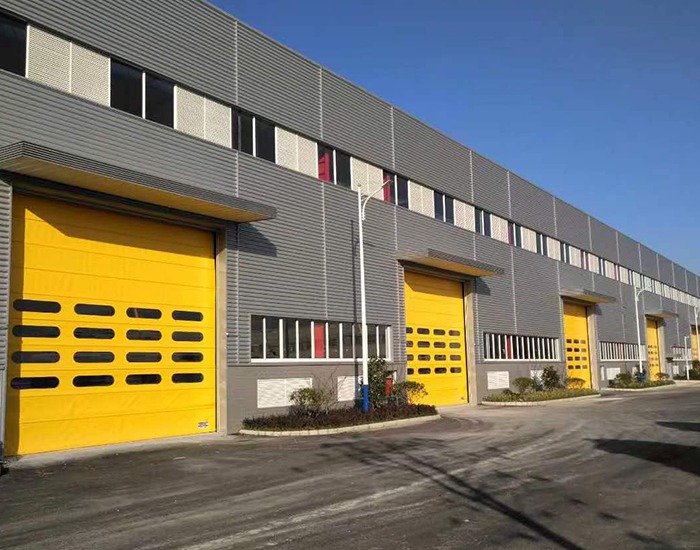
Public Buildings: Underground car parks, fire stations, environmental treatment facilities, agricultural greenhouses
General Industry: External doorways of factory buildings, equipment access corridors, high-traffic logistics access points
Spiral High Speed Door Installation Requirements
Space Dimensions Requirements
Space above the door opening: (h) ≥ 900 mm (minimum height required for standard installation of the Turbine track).
Space on either side of the door opening (b1/b2): Allow ≥ 150–200 mm on each side for installation of the track and frame.
Depth of the door opening: Determined by the door panel thickness and track dimensions; typically ≥ 300 mm.
Ceiling height: Must provide sufficient space for the door panel to be fully retracted; a height of at least the door opening height plus 1000mm is recommended.
Structural Requirements
Walls: The walls on either side of the door opening must be solid load-bearing walls (concrete or brick-concrete) capable of withstanding the dynamic loads generated by the door’s operation and its own weight; lightweight partition walls must be reinforced.
Floor: The floor of the door opening must be level and hardened, with a levelness tolerance of ≤ 3 mm, to ensure proper contact with the bottom seal.
Ceiling: The lintel at the top of the door opening must be of sufficient strength to support the helical track and drive unit.
Embedded Fittings: Reserve positions for embedded fittings or expansion bolt holes in accordance with the installation drawings provided by the manufacturer.
Electrical Requirements
Power supply: 380V three-phase five-wire system (or 220V single-phase, depending on motor specifications), 50Hz; power rating to be configured according to the size of the door.
Power Distribution: A dedicated distribution box must be provided near the door, equipped with a residual current device (RCD) and an emergency stop switch.
Earthing: Reliable earthing must be provided, with an earth resistance of ≤ 4Ω.
Control Cables: Where integration with devices such as radar, ground loops or card readers is required, appropriate signal cable conduits must be provided.
Environmental Requirements
Operating temperature: Typically -30°C to +50°C (in low-temperature environments, a frost-protected motor and heating device must be fitted).
Protection: For outdoor installation, protection against rain and sunlight must be provided; the electrical control box must have a protection rating of IP54 or higher.
Corrosive environments: In corrosive environments such as chemical plants and coastal areas, a stainless steel frame or anti-corrosion coating must be fitted.