Types, Advantages and Applications of Dock Leveler Door Seals
Blog 2026-09-07
Loading dock door seals are installed around the perimeter of warehouse loading doors. When a truck is docked, they fill the gap between the rear of the truck and the wall, creating a sealed working passage. They serve as standard sealing equipment for loading docks and overhead doors.
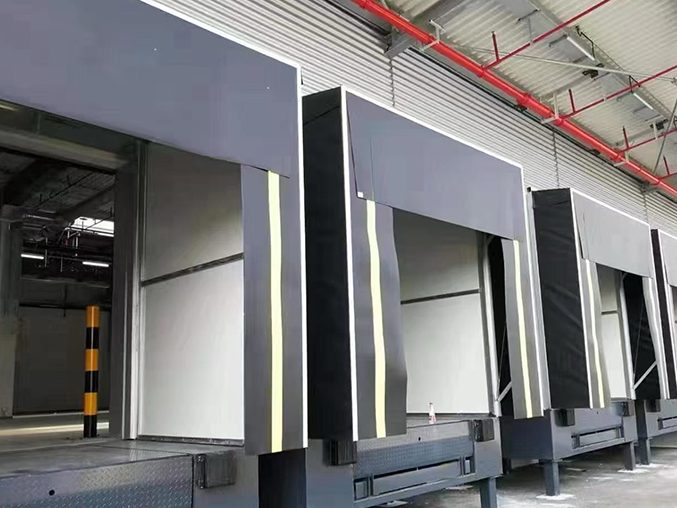
Sponge-type Door Seal
How It Works
Once the truck has backed into position, the rear of the cargo compartment presses directly against the foam blocks. The foam rebounds and snugly seals against all three sides of the cargo compartment, achieving a seal through physical compression.
Structural Composition
Galvanized steel mounting frame + rain-proof top curtain;
Sealing blocks on the left and right sides + top foam block, filled with high-density, high-resilience polyurethane foam;
Outer layer of thickened, wear-resistant PVC/polyester fiber waterproof fabric, with a yellow warning strip on the front and pressure-absorbing pleats for cushioning.
Advantages
Tight seals, excellent thermal insulation, low cost, simple structure, virtually no vulnerable components, and minimal maintenance;
Resistant to low temperatures, suitable for cold storage facilities, cold chains, and food processing plants.
Suitable Applications
Cold chain cold stores, temperature-controlled food warehouses, logistics parks with standardised vehicle types, medium budgets, and long-term low-temperature operating conditions.
Mechanical Door Seal
How It Works
The side curtains are pressed against the top of the cargo compartment, and the top curtain flexibly expands outward. The curtain fabric wraps around both sides and the top of the cargo compartment, forming a completely enclosed enclosure.
Structural Composition
Aluminum alloy / galvanized steel frame + spring-loaded telescoping link support system;
Flexible top curtain and large-size vertical PVC sealing curtains on the left and right sides;
Fiberglass support strips; when the curtain fabric is pressed by a vehicle, it yields outward, and automatically springs back into place once the vehicle moves away.
Advantages
Compatible with a variety of trucks of varying heights and widths; exerts no compressive force on walls, making it the preferred choice for light-gauge steel buildings and color-coated steel panel walls; provides excellent impact absorption, minimizing damage to both vehicles and door seals.
Suitable Applications
Integrated logistics parks, general warehousing, mixed loading and unloading of various vehicle types, insufficient load-bearing capacity of factory walls, and frequent entry and exit of lorries of all sizes.
Inflatable Door Seal
How It Works
Once the vehicle has come to a complete stop and the sectional door has opened, the fan starts up and the air bladders rapidly inflate, completely enveloping the vehicle’s sides to achieve a near-airtight seal; the air is automatically released once the operation is complete.
Structural Composition
Double-layered insulated steel panel frame, aluminium alloy corner profiles;
Thickened airtight air chambers at the top and on both sides;
Equipped with a silent blower, constant-pressure exhaust valve and automatic start-stop control system
Advantages
Offers the highest level of sealing, an extremely low air leakage rate and optimum temperature control accuracy; the air bladders are highly flexible and compatible with lorries of all sizes; features a built-in air-drying function to blow rainwater and snow off the surface of the load compartment.
Suitable Scenarios
Ultra-low-temperature cold stores, pharmaceutical cleanrooms, high-end fresh produce cold chains, temperature-controlled electronics production facilities, and workshops requiring strict temperature and humidity control.
Model Comparison Table
| Comparison | Sponge-type door seal | Mechanical door seal | Inflatable door seal |
| Sealing rating | High | Medium | Very high |
| Vehicle Compatibility | Standard lorries | All sizes | All models |
| Wall loads | Compressive thrust present | No compressive load; suitable for lightweight walls | No compressive load |
| Thermal insulation and energy efficiency | Excellent | Average | Top-class |
| Equipment costs | low | medium | high |
| Typical Industries | Cold chain cold stores, food processing plants | General logistics, multi-purpose warehouses | Pharmaceuticals, ultra-low-temperature cold stores, cleanrooms |
Complete System (Integrated Loading Bay Solution)
A standard loading bay comprises four main pieces of equipment, with the dock seal serving as the core sealing component:
1. Industrial insulated sectional door: provides basic protection for the door opening;
2. Hydraulic loading platform : bridges the height difference between the warehouse and the vehicle;
3. Loading bay door seal: seals the gap between the vehicle and the building wall;
4. Auxiliary fittings: vehicle wheel stops, traffic light signalling system, crash barriers and rain-proof canopy.
Installation Guidelines
Installation Location
Around the perimeter of the external wall of the door opening; the clear width and height of the door opening must be sufficient to accommodate the dimensions of the door seal
Foundation Requirements
Foam door seals: The wall must be made of concrete or reinforced steel to withstand the reaction force exerted by the foam;
Mechanical/inflatable door seals: Can be installed on both light-gauge steel cladding and brick walls;
Installation Steps
Secure the outer frame to the wall anchors;
Install the top curtain, foam blocks or airbag assembly;
Secure the warning wear-resistant strip;
For the inflatable model, connect the blower and interlock control wiring;
Commission the rebound mechanism, inflation start/stop functions and interlocking with the sectional door;
Clearance Dimensions
Standard door opening width 3000–3500 mm, height 3200–4200 mm; the outer frame of the door seal extends 300–500 mm beyond each side of the opening