Comprehensive Selection Guide for Industrial Sectional Doors
Blog 2026-08-17
Industrial Sectional Doors, also known as sectional lift doors or electric sliding-lift doors, are the most commonly used specialised doors for industrial premises and logistics warehouses. They consist of multiple insulated door panels, side tracks, a torsion spring balancing system and an electric drive mechanism.
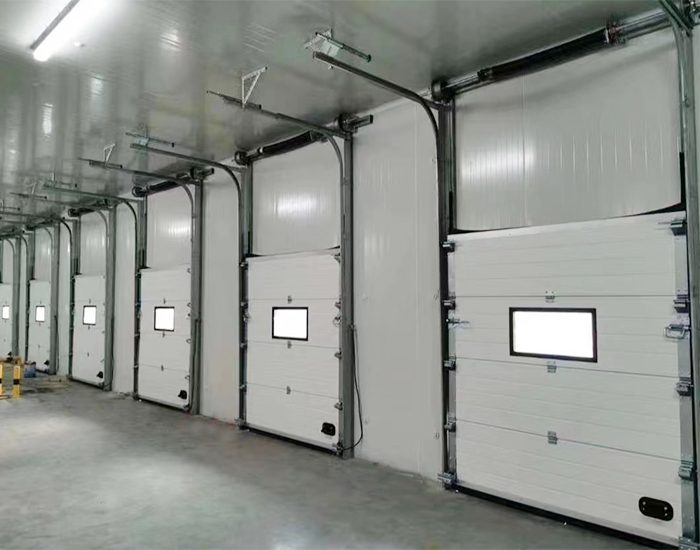
On-site survey to determine the door opening and headroom (to decide the lifting method)
Four Main Lifting Methods for Sectional Doors
Standard Upward-Folding Lifting (Commonly Used)
Headroom requirement: ≥ 1/2 of the door opening height, minimum 500 mm
Suitable for: Standard warehouses, workshops, lorry access points, and most industrial premises
Features: The door panel swings upwards to sit flush against the underside of the roof, taking up no vertical space inside the building; offers excellent value for money
Vertical Lift (Straight-Lift Type)
Headroom requirement: ≥ Clear height of the door opening H (the entire door stands upright against the wall when fully open)
Suitable for: Door openings with overhead cranes or pipework above, sufficient floor-to-ceiling height, and workshops housing large equipment
Advantages: No obstruction at the top of the sectional door when fully open; allows unhindered access for extra-tall lorries and equipment
Low-profile lift (for low ceilings / small attics)
Requires only 300–400 mm of headroom; commonly used for factory canopies, low-ceilinged outbuildings and garages
Disadvantages: The sloping track occupies a small amount of interior space; opening speed is slightly slower
High-profile lift
Suitable for spaces with ample headroom, where the door is raised above the beam; ideal for indoor facilities with mezzanines or multi-storey warehouses
Selection of Balancing Systems
The balancing system (torsion springs) determines the service life of the door
Standard dimensions (width ≤ 6 m, height ≤ 5 m): Dual torsion spring balancing system
Extra-large door openings (width > 6 m / height > 5 m): Multiple sets of torsion springs + reinforced balancing shaft
Material standard: 60Si2Mn spring steel, service life ≥ 30,000 cycles, with torsion spring breakage protection device as standard
Drive System Selection
Shaft-driven motor (recommended for industrial use): Directly drives the balance shaft, offering low noise levels and a low failure rate
Control and activation methods can be selected as required
Basic: Remote control + wall-mounted push-button, manual clutch (manual operation in the event of a power cut)
High-frequency logistics: Ground-mounted magnetic loops, radar sensors, Bluetooth card access, number plate recognition, AGV integration
Smart: Remote control via mobile app, access control interlocking, scheduled door opening and closing
Safety Features
Bottom airbag: rebounds immediately upon encountering an obstacle during descent
Wire rope break safety lock and torsion spring break protector (to prevent the door from falling)
Motor overload, overcurrent and overheat protection
Fully enclosed anti-derailment rails to prevent rollers from coming off the track
Infrared safety light curtain (opposite beams on both sides of the door to prevent pedestrians from being trapped)
Warning lights and audible and visual alarms
Aluminium anti-collision threshold at the bottom to protect the door panel from forklift impacts
Selection of Seals, Tracks and Fittings
Tracks: For door openings < 6 m, use 2-inch tracks; for large doors > 6 m, use 3-inch reinforced tracks made from 2 mm hot-dip galvanised steel sheet
Seals: Full set of EPDM rubber strips for the top, both sides and bottom; double-layer seals to be fitted for cold stores and cleanrooms
Rollers / Hinges: Nylon ball-bearing silent rollers and stainless steel hinges; all-stainless-steel fittings for humid environments