Reasons for choosing flexible lifting doors for aircraft hangars
Blog 2026-10-20
Hangar doors are essential facilities at general aviation airports, helicopter bases and aircraft maintenance centres.
In response to challenges such as exceptionally large openings, strong winds, the need for dust and rain protection, and constraints on structural space, flexible lifting doors (stacked-type hangar doors) have become the preferred solution for contemporary aircraft hangar projects. Combining large spans, lightweight construction, high wind resistance and low construction costs, they are widely used in helicopter hangars, general aviation parking hangars and hangar refurbishment projects.
Performance Features
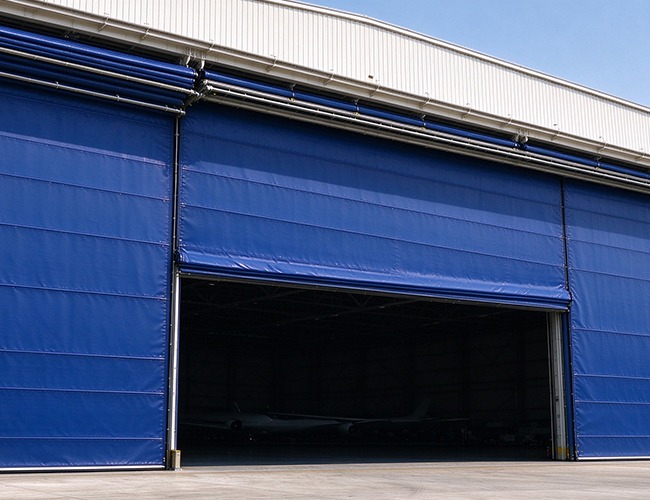
Flexible lifting doors consist of a double-layered, high-strength PVC polyester fibre curtain, a transverse steel wind-resistant truss, heavy-duty guide rails, a drive system and multiple safety protection devices. When opened, the curtain and the wind-resistant crossbeam are stacked layer by layer above the door opening, moving vertically; when closed, multiple sealing mechanisms effectively block out wind, rain and dust. This is a specialised door designed specifically for extra-large openings.
Unlike sliding hangar doors and steel hydraulic folding doors, flexible lifting doors do not require space to be set aside on either side of the doorway, nor do they require floor tracks, meaning they involve minimal alterations to the existing structure and are suitable for both new builds and the refurbishment of existing hangars.
Key Strengths
Vertical Stacking Opening Mechanism
With its stackable design, it does not take up space on either side of the doorway and does not require side access doors. It is suitable for situations where the hangar walls are adjacent to ancillary buildings and space is limited, and is suitable for both new builds and the refurbishment of existing hangars.
The Door is Lightweight
The main structure consists of flexible industrial fabric and a steel wind-resistant truss, making it considerably lighter than an all-steel hangar door. This reduces the load on the hangar roof and saves on structural reinforcement costs.
Custom-made for Extra-large Spans
Flexible lifting doors Can be customised to meet the requirements of extra-wide, extra-high, large-span openings in aircraft hangars;
The lateral wind-resistant trusses have undergone structural analysis and can be tailored to local wind loads, making them suitable for strong inland winds, coastal typhoons and salt-fog environments.
Dustproof, Waterproof and Moisture-proof
Double-layered PVC-polyester curtain fabric, fitted with side brushes and an elastic air-cushion seal at the base, to keep out rain and dust and protect the aircraft fuselage and avionics;
The fabric is UV-resistant, anti-ageing and corrosion-resistant.
Safety and Security
Comes as standard with a wire rope fall arrest lock, infrared safety light curtain, anti-jam reversal, emergency stop and overload protection;
Supports manual emergency opening and closing in the event of a power cut; can be expanded to include wind-sensing interlock, side door interlock and centralised PLC control.
Low Maintenance Costs
If part of the curtain is damaged, individual panels can be replaced without having to replace the entire door; with few moving parts, the failure rate is low and maintenance is straightforward.
Taking into account a range of factors—including space, cost, wind resistance and long-term maintenance—the selection of high-quality flexible lifting doors for aircraft hangars represents the best value-for-money option for general aviation hangars and helicopter hangars.